
“Fly tying is a school from which we never graduate”
RAMBLINGS OF A FLY TYER
This month’s fly is going to be very easy to tie but very effective on rivers, small streams, spring creeks and still waters. I first tied it when I was still in high school and gave it the name “caddis worm”. After coming home from overseas, I started my education in biology, and the “caddis worm” became “rock worms”, “midges” and more. I’ve worked the pattern over in the last 50 years, but I’m quite sure many others have tied it exactly the same. That is why I don’t put my name on a fly… someone, somewhere has probably already tied it. Ego is rampant in this hobby! OK, I’ll get off my high horse. Let’s get to tying!
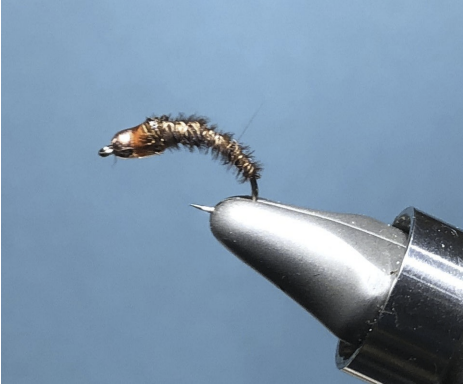
Pattern
Thread: Color brown, whatever size you like. I prefer as small as I can go so I can tie with less bulk.
Hook: Daiichi or your favorite scud hook , 1160 – 1167 (same hook, different color), or any curved hook.
Bead: Copper (or whatever you think looks best), sized to match hook; Glass bead for shallow water and slow spring creeks.
Body: Pheasant tail or turkey tail in any color you need. The picture is natural pheasant tail.
Rib: Copper rib – x small ultra wire. I believe all the shops in town carry it, as well as the pheasant tail.
To make the fly drift the way I want it to (I fish mostly on slow spring creeks), after pinching down the barb and putting on the bead, wrap enough lead (for a 16 hook and a 5/64 bead I will use 7 wraps of .010 lead wire), then start thread. Tie in copper wire half way down, then wrap wire 10 to 12 wraps, then wrap all with thread, wrapping down wire and tag end to bend of hook. Tie in about 5 barbs of pheasant tail, twist and wrap. Sometimes you need more, if so, use about 7 barbs, then twist and wrap forward, tie off and cement head. I tie it in 12’s to 20’s in natural, black, red and olive. Be sure you tie several for yourself, don’t tie just one!!