
“Fly tying is a school from which we never graduate”
TYING NEWS
The Southern Oregon Fly Tyers invite you to attend their meetings the second Tuesday of each month. The next meeting is October 12, 2010. The meetings start at 6:00 PM, at the Madrone Hill Mobile Home Park community building near Gold Hill. Bring a friend, come early so you don’t miss anything, and stay late. Tyers need not be experienced, and those with all levels of skill are welcome. Each meeting a member is encouraged to demonstrate a new or different skill, from simple to difficult. For more information, call Dan Kellogg at 773-4724.
DIRECTIONS: Take Gold Hill Exit #40, off of I-5 and go west, toward Jacksonville, 1.3 miles, until you reach the brick entrance way to the Madrone Hill Mobile Home Park on the right. You’ll pass a golf course parking lot on Your left shortly after leaving the freeway. After you turn right into the mobile home park, proceed to the community building which is located about 100 yards ahead on the left. The address is 8401 Old Stage Rd. Please park your vehicle on the bare dirt in the parking lot to avoid the wooden septic covers in the grass.
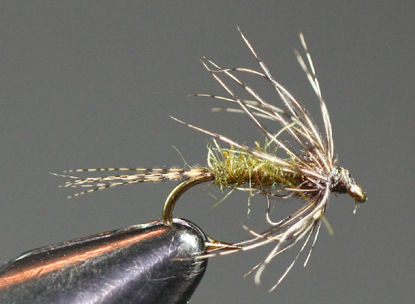
PATTERN OF THE MONTH – BWO Soft Hackle Emerger
Hook: Daiichi 1530, 2X heavy wet, size 14 – 24
Thread: 8-0 black.
Tail: 4-6 grey partridge fibers.
Body: Olive synthetic dubbing.
Thorax: Hare’s ear.
Hackle: Gray partridge.
Head: Black thread
Tying Instructions
Step 1 Mash the barb and mount the hook in the vise.
Step 2: Start the thread two eye widths behind the eye and lay down an even thread base to just above the hook barb.
Step 3: Select 4-6 gray partridge fibers, measure for one shank length, and tie on just above the barb. Secure the butts to the shank with thread wraps and trim excess. Return thread to the base of the tail.
Step 4: Sparsely dub the thread and wind forward forming a slightly tapered body covering 3/4 of the body length. Secure with thread warps and trim excess.
Step 5: Wax about one inch of the tying thread and touch dub the hare’s ear to the sticky thread. Now twist the thread a few times and wind it forward 3 or 4 turns to form the thorax. Tie off and remove excess dubbing.
Step 6: Select a gray partridge feather with barbs that will reach the bend of the hook. Prepare the feather by removing the fluff and fibers along the stiff base of the stem. Tie in the feather by the tip so the concave side is facing rearward. Now wind the feather forward two turns while stroking the fibers to the rear over the body. Tie off and trim.
Step 7: Form a neat tapered head with the thread, whip finish and cement.
It’s that time of the year when the most common mayfly hatch on our home waters is the Blue Winged Olive. The name is an informal term given to an indistinct group of mayflies that have similar appearance, life cycle, and habits. There is some debate as to which and how many mayflies are actually included in this group. Blue-winged olives are just referred to as BWO. Common characteristics include body, thorax, and leg and wing colors. Shades vary with many species and locations. One feature common to all BWO’s is that they have two tails instead of three. Most are categorized as small, ranging from size 14 to 28 hooks. Hatch times vary widely from region to region and stream to stream. Spring fed creeks or tail waters with constant cool water temperatures often support a “10 am” hatch. Cool days with drissly rains or even snow flurries are favored by BWO’s.
There are hundred of patterns to choose from and lots of good opportunity for the dry fly. There are also numerous occasions when the dry, no matter how precisely you match the hatch, just doesn’t work. That’s when the BWO Soft Hackle Emerger can save the day by imitating both the emerging stage and the egg laying or drowned adult. Fish will often key on the exact size and color, so take some samples. Just a few soft-hackle dressings in various colors and sizes will put you into business when you might otherwise find the fishing very slow.
Dave Hughes in his book Wet Flies says this about the soft-hackle. “Knowledgeable fishermen, many of whom spend a lot of hours on the water, are finding that they catch a higher percentage of their trout on soft hackles each season. They’re beginning to discover that these simple dressings look a lot like more and more of what nature offers trout in the way of things to eat. Therefore, they are turning to soft-hackles more and more often.”
TYING TIPS
There is no limit on how you can vary this pattern. The body can be light or dark olive, gray or brown olive. Have lots of sizes in your box, the fish will key on that. On smaller sizes in the 20’s, it may be more difficult to find hackle with fibers short enough. Try other species such as chucker or quail. On the smallest sizes I use the gray feathers from the underside of the starling wing, perfect color and size. So tie some up, give them a test flight, and let me know how you do.
Tie One On,
Dan Kellogg (you can contact me at FLYGUY@EZNORTHWEST.COM)