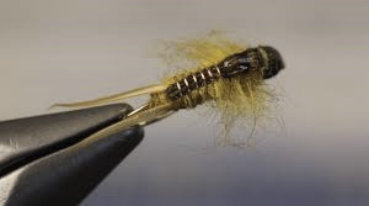
Fly of the Month
Golden Stonefly Nymph
Hook: 3X-long nymph hook sizes 8-16.
Bead: Black, 7/64-inch.
Weight: Lead-free round wire, .020.
Thread: Yellow, 8/0 or 70-denier.
Dubbing ball: Golden Stone Australian possum.
Rib: Gold Ultra Wire, brassie size.
Tails: Amber goose biots.
Back/Wingpads: Dyed-yellow pheasant tail fibers.
Body: Golden Stone Australian possum.
Adhesive: UV-cure glue.
Tools: Needle-nose pliers, bodkin.
After inserting bead on hook and hook on vise, wrap lead wire from point/barb area up to bead. Push into the bead cavity and snip excess. Start thread right behind the lead and wrap over the wire and back 2 or 3 times. Then flatten wire with pliers to more closely resemble the stonefly profile.
Make a short dubbing noodle at the bend and wrap it to a slightly bigger diameter than the lead.
Tail: Tie in a biot on each side of the fly – shank length. Take thread to bead.
Rib: Tie in gold Ultra wire on top and wrap back from bead toward tail. Let the wire drift to the far side of the hook so as not to affect the tails when later wrapped.
Shellback: Pull a clump of pheasant tail fibers straight out from the feather shaft to align the tips. Snip and tie in by the tips on top of fly. Wrap over up to bead and back. This will serve as both the shellback and the wingcase.
Abdomen : Make another dubbing noodle, about 3 inches long. Wrap forward to a point which is about halfway between the hook point and the front of the hook eye. Pull the pheasant tails forward and tie down at the end of the abdomen dubbing. Don’t snip. Now wrap the rib wire forward over the abdomen/shellback, 6 or 7 turns. Tie down and snip the excess wire but not the pheasant tails.
Thorax: Make another dubbing noodle, about 2″, same material. Hold the pheasant tails back and wrap the noodle back and into the abdomen area a bit. Wrap the thorax to be slightly fatter than the abdomen. Tie down at midpoint of thorax area. Then pull the PTs over and tie down to complete the first wing pad. Don’t snip yet.
Make another 2″ dubbing noodle and wrap to complete the thorax. Pull the pheasant tail wingcase forward and tie down. Whip finish right behind the eye, filling in the gap behind the bead with thread as needed.
Coat the wing pad pheasant tails with UV resin and cure. Then pick out the thorax dubbing with your bodkin to represent the legs.
The golden stones hatch starts shortly after the salmon flies and hatch longer. Being about 3/4″ long, +/ 1/8″, (excluding tail and antennae), they are smaller than salmon flies but found on more rivers. The nymphs are a food source both before and after the month long hatch period. This is an ideal time to give ’em a try – rolling them along the bottom! Tim Flager’s video for this pattern can be found at https://www.youtube.com/watch?v=zhdYINHAS9Y.
Jon Iverson 541-292-1871